The moment ‘food’ entered my thoughtscape, vivid memories, some in sepia and some in colour came up from dusty albums of my mind.
A savored memory from around 1987 to 1997: I was the apple of my dadima’s eyes. My grandma passed away almost 3 decades ago when I was only 16, but to this date I have never eaten a besan ki chakki or moth ka saag without remembering her or recalling the deliciousness that rubbed off from her hands. That perfect flakiness of the chakki and the right tanginess of the legumes are still distinct in my memory.
A lingering memory from 1987 to 2006: I got married in 2006, and since then I have rarely eaten my mom’s shahi tukda or cheese toasts. But they remain emboldened in my memory for eternity. Every time she made those sugary, syrupy toasts for little me, I heard my mom’s ‘love you’ dripping from the sweet bread squares. Likewise, her lip-smacking cheese toasts have always been and still are an integral family tradition of all special birthday breakfasts.
A sunny memory from 1999-2002: I graduated from Delhi University, and parathas were a staple supply in North Indian homes. Even today, biting into a gobi or an aloo paratha anywhere in the world transports me back to my mama’s breakfast table in Delhi. My mamiji served us hot and crisp parathas in the beautiful wintry chill, with cups of steaming chai and our riotous laughter in the background. Years have passed since, and I have lost my mama and mamiji, but that relished memory still warms my heart.
What is it about food that holds our precious memories so delectably, treasures the human connection so tenderly, and builds our bond with itself so earnestly? My chance listening to a rerun episode of Shubhanshu Shukla’s Axiom-4 space mission on the radio, prompted me to write this blog post. What really caught my attention in that episode was that among all the other fascinating aspects of his cosmic journey, 3 Indian food delicacies that he carried along over that high-impact, high-risk mission became the national talking point. Imagine the incredible kismet of our moong dal halwa, gajar ka halwa, and aamras, which shared prestigious space-table, and time in the most eminent company while performing a euphoric molecular dance.
Capt. Shukla gushes in the interview how every supper became a stage for cultural osmosis. The entire crew from across the globe shared each other’s dishes while exchanging stories and memories behind them and making new ones.
I felt a certain honesty in his words because I love to cook. Every time I light the stove for a regular dish or to experiment with something novel, I feel as though I pour a part of myself into the skillet, even if it’s two ordinary parathas in my children’s tiffin box. With every flip and every stir, I hope to sprinkle some joy and fold in a spoon of care in the servings. And Mr. Shukla’s words made me realize that perhaps food does carry all the emotions you imbue it with because how else could it become such a language of community bonding and a culinary archive of personal inheritance and experiences?
Strangely, ever since I started stringing this piece, food has been omnipresent in my every sphere. The movie I watched, Voicemails for Isabelle, is about a chef who discovers liberation through a dish that she created for her dying sister. The book I read, The Last Promise, has a Tuscan kitchen filled with aromas of sage-infused sauces, freshly cooked tortellini, and zesty wines. The Hindu’s cover story on how YouTube recipes are revolutionizing Indian kitchens and kitchen helps even inspired me to try mushroom stroganoff.
But for those unfamiliar with kitchen tropes, let me warn you; it’s not all passion, nostalgia, and romance in Pinterest kitchens. There’s as much hassle, hard work, planning, and mundanity that go along with it. Ask a homemaker, including myself, and she’ll tell you the excess energy and thought she spends on providing a hot casserole on the table, especially with new and varied diets for almost everyone in the family. Sometimes, I wonder if we live on food or if we live for food.
Which begs the question: How did food—a basic biological need—turn into one of the most celebrated, enmeshed, and extraordinary aspects of human life? From its nutritional necessity, how did it permeate into cultural, geographical, scientific, traditional, and spiritual layers of our living? How did it metamorphose from an object of sustenance to a personal memory bank? How did it transform from a plate of comfort food to Michelin-star art evoking all sensual cells simultaneously?
The journey and evolution of food are closely integrated with the history of our world – its invasions, conquests, new settlements, nomadic wanderings, climatic adaptations, and its surreal ability to kindle emotions and carry fragments of time and space in its human consumers. Once a willing and feeling consumer is identified, a capitalist industry spins itself around it naturally enough. That explains how the simple tradition of cooking and the function of eating turned into a behemoth, gargantuan industry with an estimated worth between 7.4 and 9.7 trillion dollars.
Aside from its economic prowess, the bread we break has another remarkable trait. I have witnessed people enjoying meals engrossed in conversations, gossip, or noisy chatter, or sometimes eating in somber quietness or even in agonized silence. But I’ve never seen people feud, wrangle, break up, or act nasty while sharing a meal sitting across from each other. This anomaly says something virtuous about that plate of food.
The earth’s produce and the act of offering and consuming it serve a nobler purpose than filling the belly and regulating the mood. To heal the body, nourish the mind and satisfy the soul. Perhaps that’s what our grandmothers, mothers, and certain chefs and cooks do to the gifts of the sun and soil. They alchemize it with the touch of their hands and love of their hearts, and such food becomes a part of our personal and collective histories, including space missions.
I started the blog with my grandma and mom, and I’ll end with an ode to them, borrowing lines from Danez Smith’s “My President.”
“& my mama is my president, her grace stunts
On amazing, brown hands breaking brown bread
Over mouths of the hungry until there are none unfed.
& my grandma is my president & her cabinet is her cabinet
Cause she knows to trust what the pan knows
How the skillet wins the war.”
~Radhika Mimani
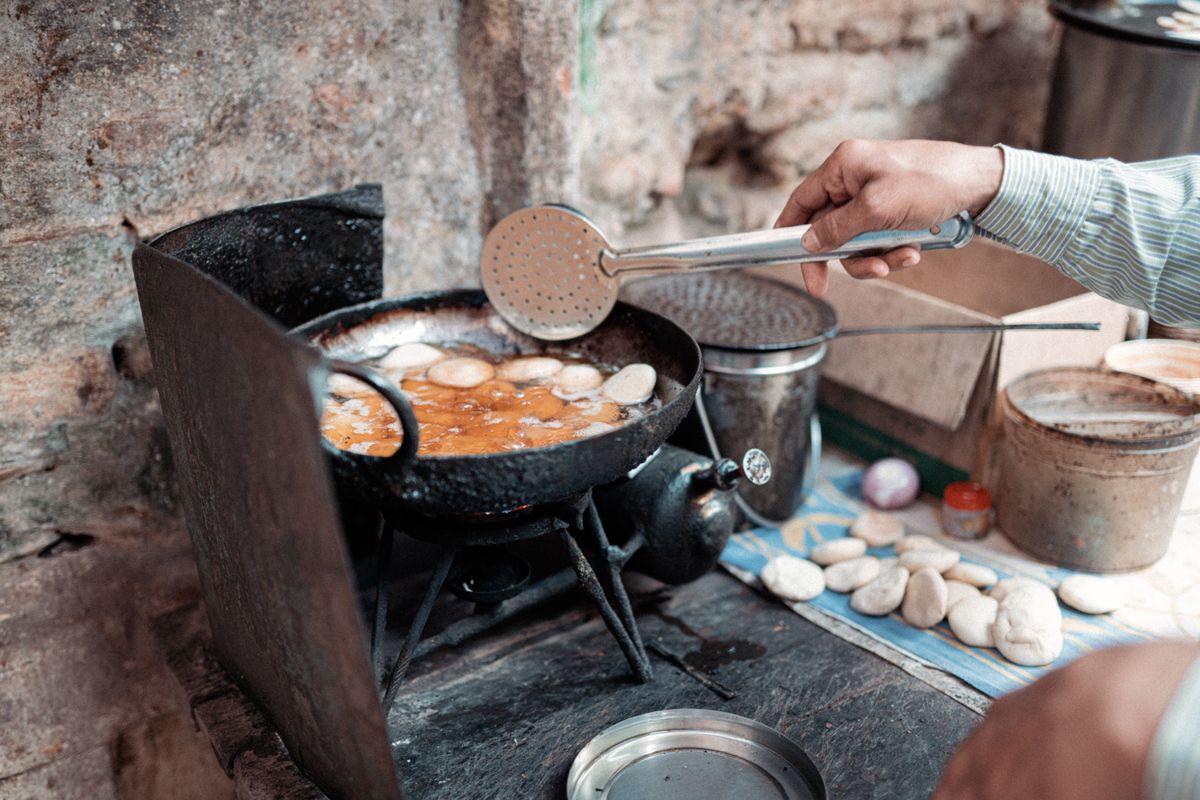
Photo by Mahmut Yılmaz: https://www.pexels.com/photo/street-food-preparation-in-varanasi-market-36853155/